By Ramiro Del Rio
Starfish in San Blas: Where to See Them Without Harm
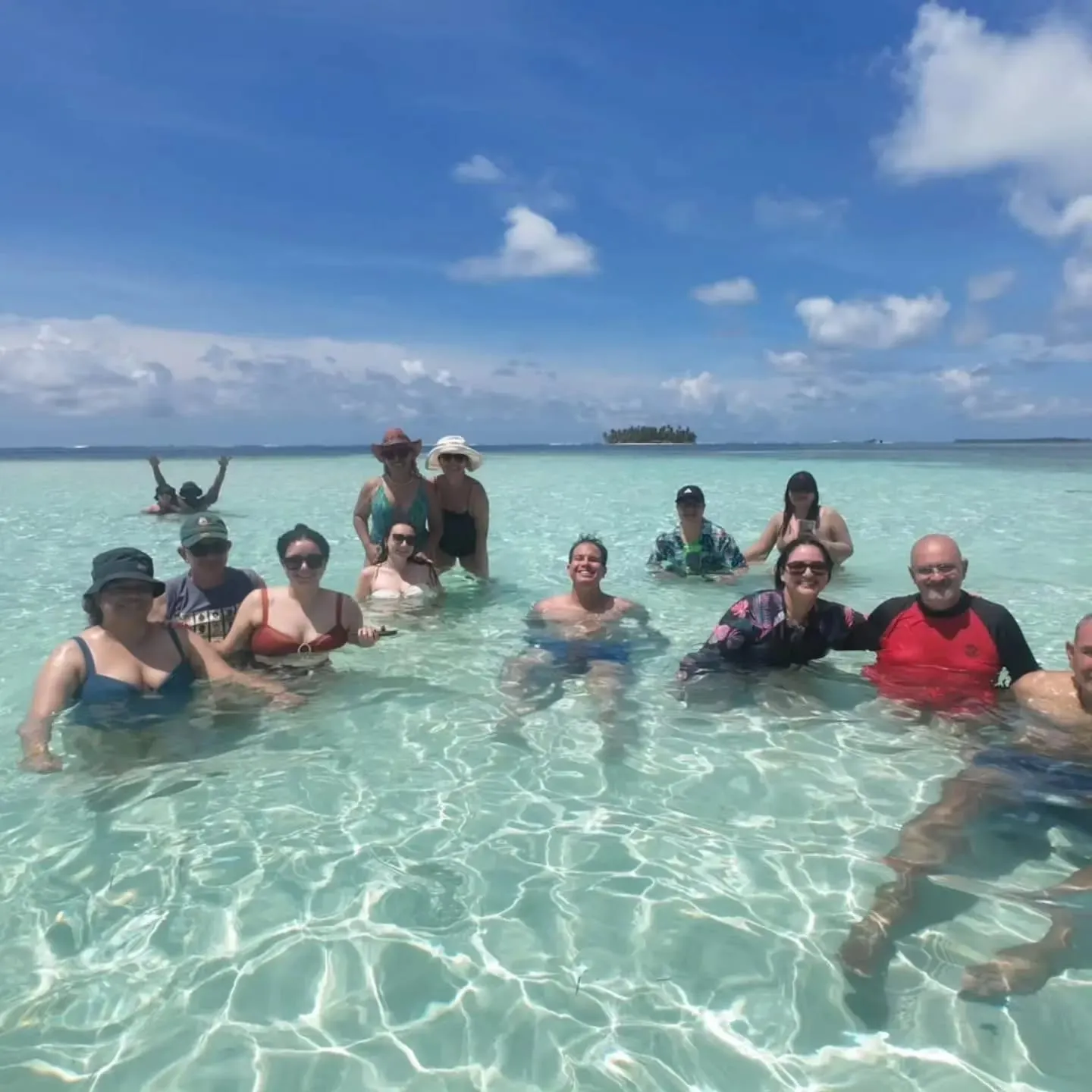
The best-known place to see starfish in San Blas is the Piscina Natural, a waist-deep sandbank where they rest on the bottom. You look at them and photograph them in the water, without lifting or touching them: they breathe through their skin, and out of the water they start to suffocate almost immediately.
Where to see them
The Piscina Natural is a sandbank in open water where the sea stays between knee and waist deep for hundreds of metres. With a bottom that clear and that shallow, you can spot the starfish from the surface without diving. That’s why it is one of the most photographed stops in the archipelago, and most of our day tours include it, such as the Classic Day · 3 Islands. Our guide to the Piscina Natural describes the place itself.
They also turn up on other shallow sand and seagrass bottoms near some of the cays. There it depends on the area and the day, and there’s no guarantee: they are wild animals, not part of the scenery.
Which starfish it is
The large, thick, orange, reddish or brown starfish you see on Caribbean sand matches the description of the cushion sea star (Oreaster reticulatus). We haven’t found a published scientific survey of the species at the Piscina Natural, so we say this with that caveat.
According to the species account on Animal Diversity Web, from the University of Michigan, the cushion sea star:
- Lives in calm, shallow water, mostly on coarse calcareous sand, alone or near seagrass beds, between 1 and 37 metres deep.
- Can reach 50 centimetres across.
- Is orange, red, yellow or brown as an adult and green as a juvenile, a colour that camouflages it in the seagrass where its larvae settle.
- Feeds on what it finds in the sediment — organic debris, sponges and small invertebrates — digesting it by pushing its stomach outside its body.
The same account notes that it has been heavily collected to sell as souvenirs. At a place as busy as the Piscina Natural, the problem isn’t one photo: it’s the same starfish lifted out of the water by dozens of different hands.
Why they stay in the water
University of Florida extension (UF/IFAS) explains it in a 2025 outreach piece, “Is your photograph worth that starfish’s life?”:
- They breathe through their skin. They have no lungs and no gills like fish: they take oxygen from the water through small structures called papulae. In air those structures collapse and the starfish begins to suffocate almost at once.
- They run on water pressure. They move and hold their shape with an internal hydraulic system. Lifting them or setting them on a dry surface can damage it beyond repair.
- Hands hurt them. Skin oils, sunscreen and the heat of your hands irritate their surface.
- The damage isn’t always visible. The stress of being lifted can kill them hours or days after they’re put back, even if they seem fine at the time.
That last point is the one people forget. A starfish that settles back on the bottom and “stays still” hasn’t necessarily come through unharmed. For the same reason, watch where you put your feet: people walk around the Piscina Natural, and the starfish are on that same bottom.
How to photograph them without harm
The good photo is taken in the water, and it looks better than a starfish in the palm of your hand.
- Use a waterproof pouch or case for your phone. That way you can bring the camera down to the waterline or under it without worrying.
- Frame it from above, with the sun behind you. The water at the Piscina Natural is so clear that it looks sharp from the surface.
- Move slowly and don’t kick up sand. Cloudy water makes the photo milky and covers the starfish.
- Get next to it, not it into your hand. Crouch beside the starfish with the water at your waist: that’s the photo that shows where you were.
- Don’t flip it or move it to get a better angle. Leave it as it is.
If you’re wearing sunscreen, choose one that won’t harm the reef, and still don’t touch the starfish. We cover that in which sunscreen is safe for the coral.
What the comarca asks
We haven’t found a written rule from the Guna General Congress dealing specifically with starfish. What is expected of every visitor to Guna Yala, and what we ask on our tours, is not to take them out of the water and not to take anything from the sea: no shells, no coral, no animals. We list it alongside the comarca’s other rules in what you can film and what visitors are asked to respect.
It’s the same logic as the comarca’s lobster closed season: what lives in these waters also belongs to the people who live here. If you want to see more marine life than the sandbank offers, our guide to snorkelling in San Blas covers the best spots. And to place the Piscina Natural among the archipelago’s hundreds of islands, see how many islands San Blas has.
Frequently asked questions
Where can you see starfish in San Blas? The best-known place is the Piscina Natural, a waist-deep sandbank where they rest on the bottom. They also appear on other shallow sand and seagrass bottoms, but there’s no guarantee of seeing them there.
Can you take starfish out of the water? No. They breathe through structures in their skin that collapse in air, and the stress can kill them hours or days after they’re returned to the sea, even if they look fine.
What species of starfish lives at the Piscina Natural? The large orange starfish on the sand matches the cushion sea star (Oreaster reticulatus), common on shallow Caribbean bottoms. There’s no published scientific survey of the site to confirm it.
How do I photograph a starfish without hurting it? In the water, with your phone in a waterproof case and without touching it. Frame it from above with the sun behind you, and move slowly so you don’t stir up the sand.