By Ramiro Del Rio
How the World Began for the Guna: Baba, Nana, Ibeorgun
For the Guna, the world was created by Baba and Nana, the Great Father and the Great Mother, who can’t be understood apart from each other. That story, together with those of teachers like Ibeorgun, makes up the Babigala: knowledge passed on by word of mouth and chanted by the sailas in the congress house.
Baba and Nana
Anthropologist Karin E. Tice, in the Encyclopedia of World Cultures entry on the Guna, notes that the creation story speaks of Pab Dummat and Nan Dummat, Big Father and Big Mother, and that the traditional religion is known as «the Father’s Way». Guna anthropologist and historian Bernal D. Castillo, who teaches at the University of Panama, translates the name of that whole body of knowledge, Babigala, as the path of Baba and Nana.
There being two of them matters. As writer Carlos Fong put it in La Prensa in 2020, in Guna religious thought neither exists without the other, and each one’s perfection depends on the other’s. Castillo adds a third element: Mother Earth, Nabgwana, and a view of the world in which forest, land and water are alive.
Many Guna also attend Catholic or Protestant churches, Tice points out. The two sit side by side.
Ibeorgun, Gikadiryai and the teachers
After creation come the teachers. The version most accessible to a visitor is Relatos de mi gran historia (2008), in which Guna researcher and poet Aiban Wagua (1944-2022) compiled, summarised and translated what three sailas chanted, for the comarca’s bilingual education programme. It’s published, in Spanish, on the official website of the Guna Yala General Congresses.
It all starts not on the islands but on the banks of the river the grandparents called Duilewala, today the Tuira, in Darién. Three young people arrive there: Ibeorgun, Wigudun and Gikadiryai.
In the story, Ibeorgun teaches people:
- how to greet each other in the morning and bathe slowly in the river;
- how to build a house, and how to raise the congress house together, as told in what a traditional Guna house is like;
- how to farm, choose seed and share the harvest;
- the chants that protect the community’s health.
Gikadiryai, his sister, teaches hammock weaving, pottery and dyeing cloth. And before them came Olonadili, a young woman from the stars who taught the grandmothers to sing to children and to mourn the dead in verse.
Castillo notes that Ibeorgun is credited with the social, cultural and political organisation that existed before the Spanish arrived. And Wagua doesn’t call these legends: his title speaks of history.
Chanting history: sailas, namakke and argar
This knowledge isn’t read, it’s chanted. Linguist Joel Sherzer, of the University of Texas, explains that the Guna world is organised through the spoken word: the mythical chants of chiefs, the histories told by leaders, the curing chants. In his word list, namakke means to chant or sing, saila is chief, and argar is the chief’s spokesman.
According to Tice, in the congress house, communities alternate political meetings with chanting gatherings, where the sailas chant history and religion full of symbolism, and then the argar explains to those present what it means. The same building serves both purposes, which partly explains how Guna Yala is governed.
Knowledge has its own institution, too. Castillo explains that alongside the Guna General Congress, which handles political and administrative affairs, there is a General Congress of Guna Culture for cultural and spiritual matters. According to Fong’s article, it was that congress that approved an earlier book by Wagua on Guna religion, En defensa de la vida y su armonía (2000).
Cosmology in the molas
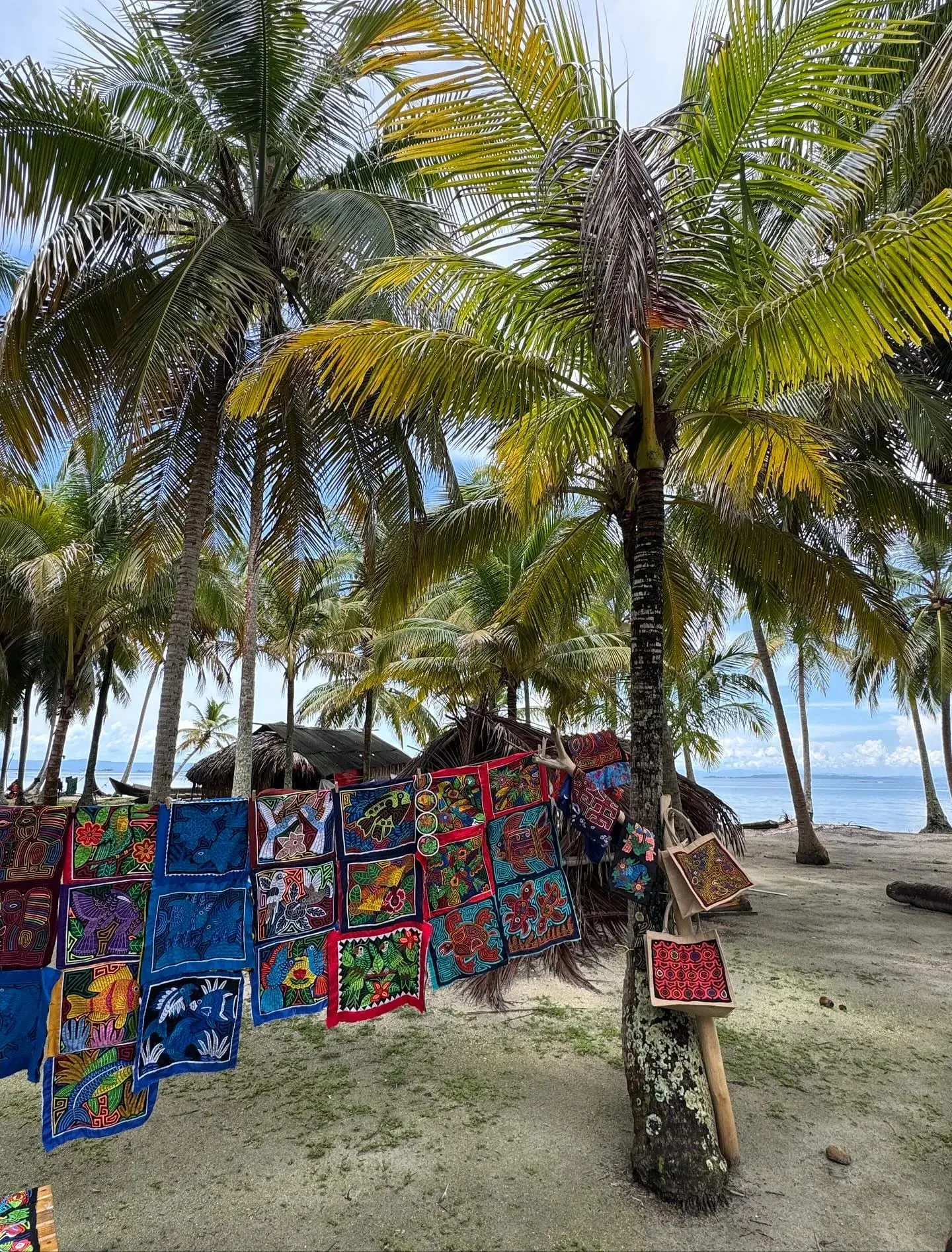
Some molas tell this way of seeing the world, though not all of them do. In Wagua’s stories, Gikadiryai teaches people to weave and dye new garments, and the mola women wear today comes later still.
Two examples documented by museums:
- The manta rays. The Lowe Art Museum at the University of Miami holds a mola showing a family of manta rays and explains that the image refers to the afterlife: in Guna belief, the manta rays become the boat that carries a fisherman who has died to see the places he wished to visit.
- The doubles. The Dallas Museum of Art, citing anthropologist Michel Perrin, links the custom of sewing molas in pairs to the Guna belief that every living being has a double.
The same museum adds a caveat worth repeating: Guna women are artists who also respond to aesthetics and to the market, and not every mola is a sacred text. More on molas, and how to buy one, in the Guna people and their molas.
Approaching it with respect
These stories aren’t a show. A few pointers:
- A meeting in the congress house is a community event. Don’t go in or record the chants without explicit permission.
- A few words help. A greeting in Dulegaya opens more doors than a question about religion; you’ll find some in useful Guna words for your trip.
- History matters. Defending this culture against those who tried to erase it is behind what happened in the 1925 Dule revolution.
If you’d like to visit an inhabited community, the Miryadup: Cultura Guna Express tour includes one, and our Guna Yala page covers the basics of the comarca.
Frequently asked questions
Who are Baba and Nana to the Guna? They are the Great Father and the Great Mother who created the world in Guna tradition. They are understood as an inseparable pair: neither exists without the other. The body of knowledge about them is called the Babigala, the path of Baba and Nana.
Who was Ibeorgun? He is one of the great teachers in Guna history. In the stories compiled by Aiban Wagua, he arrived on the banks of the Tuira river and taught people to build houses and the congress house, to farm and to look after the community’s health.
What do the sailas and the argar do in a Guna congress? The sailas are the traditional authorities, and at chanting gatherings they chant the people’s history and religion. The argar is their spokesman: he explains to those present what those symbol-laden chants mean.
Do molas depict Guna cosmology? Some do. Museums such as the Lowe at the University of Miami document molas with images of the afterlife, and the custom of sewing them in pairs is linked to the belief in doubles. But many molas reflect the aesthetic choices and taste of each artist.